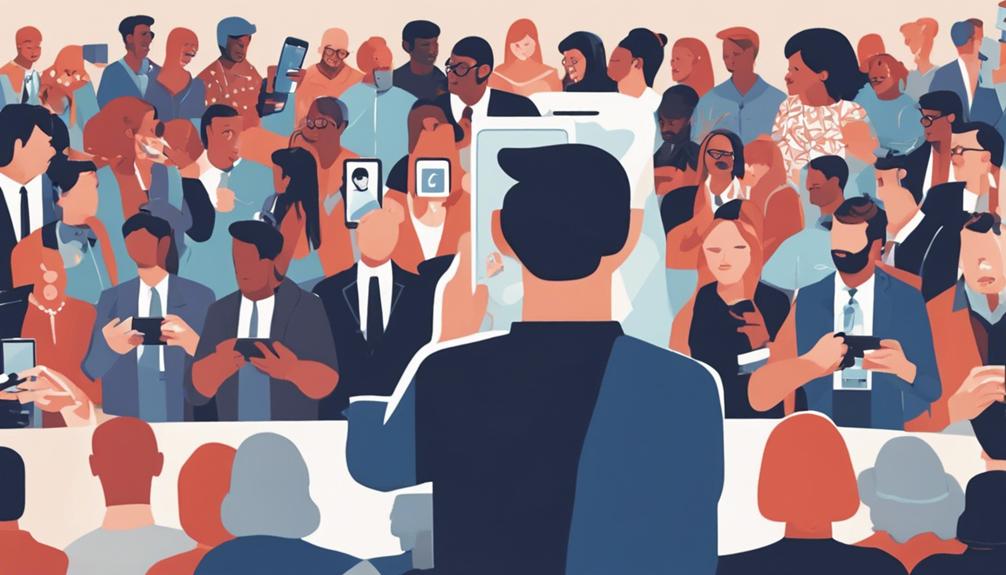
We've seen a dramatic shift in how politicians connect with us, thanks to social media. These platforms have transformed political communication, allowing for real-time engagement and immediacy. Online influencers now shape public opinion, competing with traditional media outlets. However, this new landscape comes with its challenges – misinformation spreads rapidly, and extremist voices are amplified. As we navigate this digital era, we must find ways to promote fact-based content, reduce misinformation, and regulate social media's influence. As we explore this complex intersection of technology and politics, we'll uncover more about the impact of social media on modern politics.
Social Media's Rise to Prominence
As we explore the world of modern politics, it's important to acknowledge that social media's rise to prominence has been nothing short of meteoric, with platforms like Facebook, Twitter, and Instagram transforming the way politicians connect with their constituents. We've witnessed a seismic shift in how politicians communicate, from traditional town halls and rallies to online engagement and digital outreach. This paradigm shift has enabled politicians to reach a wider audience, build a personal brand, and share their message with unprecedented ease.
We're no longer limited by geographical boundaries or time zones; social media has made it possible for politicians to engage with citizens in real-time, fostering a sense of immediacy and connection. We've seen how social media influencers and online personalities have become key players in shaping public opinion, often rivaling traditional media outlets in reaching and influence. Additionally, social media's interactive nature has enabled citizens to participate in the political process like never before, with online petitions, hashtag campaigns, and digital activism becoming essential tools for mobilizing public support. As we navigate this new landscape, it's clear that social media's impact on modern politics will continue to evolve, presenting both opportunities and challenges for politicians, citizens, and the democratic process as a whole.
Political Campaigns in the Digital Age
We're now witnessing a fundamental transformation of political campaigns, as social media's influence has reshaped the way candidates connect with voters, raise funds, and craft their messages. This shift has led to a more personalized and targeted approach, allowing candidates to tailor their messages to specific demographics and interests. Social media platforms have become essential tools for candidates to build their brand, share their vision, and engage with voters in real-time.
We've seen a significant increase in online fundraising, with social media platforms providing a conduit for small donations from a large number of people. This democratization of fundraising has leveled the playing field, enabling lesser-known candidates to compete with more established opponents. In addition, social media has enabled candidates to bypass traditional media outlets, allowing them to communicate directly with voters and bypass editorial filters.
As we navigate this new landscape, it's clear that social media has become an indispensable component of modern political campaigns. Candidates who fail to adapt to this new reality risk being left behind. We're no longer in an era where a single televised debate or print advertisement can make or break a campaign. Today, it's about building a strong online presence, engaging with voters, and leveraging social media to amplify one's message. As we move forward, it will be fascinating to see how candidates continue to innovate and adapt in this digital age.
The Spread of Misinformation Online
In addition to social media's amplification of misinformation, there is a pressing concern about false or misleading information spreading rapidly online, often with devastating consequences for public discourse and political decision-making. We've all witnessed how quickly a false narrative can spread like wildfire on social media, often going viral before the truth can even get its boots on. This phenomenon has significant implications for modern politics, as it can influence public opinion, sway political decisions, and even shape the outcome of elections.
We're not just talking about minor inaccuracies or biases, but outright falsehoods that can have real-world consequences. For instance, misinformation about vaccines has led to a resurgence of preventable diseases, while false information about elections has eroded trust in democratic institutions. The speed and reach of social media platforms have created an environment where misinformation can spread faster than fact-checkers can debunk it.
As users, we have a critical role to play in combating misinformation. We must be vigilant in verifying information before sharing it, and we should hold our elected officials accountable for spreading misinformation. Additionally, social media companies must take responsibility for promoting fact-based content and reducing the spread of misinformation on their platforms. By working together, we can mitigate the harm caused by misinformation and promote a more informed public discourse.
Amplifying Extremist Voices and Hate
While misinformation poses a significant threat to modern politics, an equally disturbing trend is the amplification of extremist voices and hate speech on social media platforms. We've witnessed how social media algorithms can inadvertently promote harmful ideologies, often by prioritizing sensational or provocative content. This creates a toxic environment where hate groups and extremist individuals can spread their harmful rhetoric, recruiting followers and normalizing discriminatory attitudes.
We've seen how social media platforms can become breeding grounds for hate speech, allowing bigoted ideologies to flourish under the guise of free speech. This not only perpetuates harmful stereotypes but also puts already vulnerable communities at risk of violence and harassment. Moreover, the anonymity provided by social media can embolden individuals to express hateful views they might not dare to express in person.
As we navigate this complex issue, we must acknowledge that social media companies bear a significant responsibility in regulating their platforms. We need to demand more from these companies, pushing them to develop and implement more effective content moderation strategies. By doing so, we can reduce the amplification of extremist voices and hate speech, creating a safer online environment that fosters constructive dialogue and promotes inclusivity.
Shaping Public Opinion and Perception
As we explore the impact of social media on modern politics, we're struck by its profound influence on shaping public opinion and perception. We're seeing how social media platforms can create and disseminate media frames that reshape our understanding of reality. By examining how social media sets the political agenda, we're uncovering the ways in which it molds our collective perspective.
Media Frames Reality
Through the strategic selection and presentation of information, the media exerts profound influence over our collective perception of reality, shaping public opinion and informing our understanding of the world around us. We tend to believe what we see and hear, and the media's framing of reality can greatly impact our attitudes and beliefs. By highlighting certain aspects of a story and downplaying others, the media can create a particular narrative that resonates with us. This, in turn, can influence our opinions on political issues, policies, and even entire politicians. We often rely on the media to inform us about current events, and their framing of reality can be incredibly persuasive. As a result, it's essential to be aware of the media's role in shaping our perceptions and to critically evaluate the information we're presented with. By doing so, we can make more informed decisions and develop a more nuanced understanding of the world around us.
Political Agenda Setting
Setting the political agenda, we discover that the media's influence extends far beyond mere reporting, as they play an essential role in shaping public opinion and perception by selectively highlighting certain issues and downplaying others. This agenda-setting power allows them to frame the narrative, deciding what issues are worthy of attention and what's relegated to the sidelines. As a result, we often find ourselves focusing on the topics the media deems important, while ignoring others that might be equally significant.
We've seen this play out in recent years, where social media platforms have become key players in setting the political agenda. With their algorithms and trending topics, they can amplify certain voices and stories, while muting others. This has significant implications, as it influences what we discuss, what we care about, and ultimately, how we vote. By shaping the narrative, the media and social media platforms have the power to sway public opinion, making them instrumental in shaping the course of modern politics. As we navigate this complex landscape, it's essential we remain aware of this influence, recognizing how our perceptions are being shaped and by whom.
The Impact on Democratic Institutions
As we examine the impact of social media on democratic institutions, we're struck by the ways in which it's eroding trust in these pillars of our society. We're seeing how social media's ability to manipulate public opinion is undermining the legitimacy of our institutions. By exploring these points, we'll uncover the ways in which social media is reshaping the foundations of our democracy.
Eroding Institutional Trust
We've witnessed a disturbing trend in which social media's unchecked influence has led to a significant erosion of trust in democratic institutions, which were once considered the pillars of our society. This decline in trust is particularly concerning, as it undermines the very foundations of our democracy. We're seeing a growing distrust in institutions like the judiciary, the media, and even the electoral process itself. Social media platforms, with their algorithm-driven echo chambers, have created an environment where misinformation and disinformation thrive. This has led to a proliferation of conspiracy theories and alternative facts, further eroding trust in institutions. We're faced with a vicious cycle where social media platforms amplify distrust, which in turn fuels further disinformation and polarization. The consequences are far-reaching, as a lack of trust in institutions can lead to widespread disillusionment and even social unrest. It's essential that we acknowledge this trend and work towards rebuilding trust in our democratic institutions before it's too late.
Manipulating Public Opinion
Through the unchecked spread of misinformation and disinformation, social media platforms have become a powerful tool for manipulating public opinion, ultimately corroding the foundations of democratic institutions. We're witnessing a subtle yet insidious erosion of trust in institutions, as false narratives and conspiracy theories spread like wildfire online. This phenomenon has far-reaching implications, as it enables special interest groups and malicious actors to sway public opinion and influence policy decisions.
The consequences are multifaceted:
- Erosion of fact-based discourse: Social media platforms prioritize sensational and provocative content, making it difficult for fact-based information to reach a wider audience.
- Polarization and fragmentation: Algorithms create echo chambers, reinforcing existing biases and fostering an 'us versus them' mentality.
- Undermining of democratic processes: Manipulated public opinion can lead to the legitimization of authoritarian regimes and the erosion of democratic norms.
We must acknowledge the gravity of this issue and take collective responsibility to promote media literacy, critical thinking, and fact-based discourse. Only then can we reclaim the integrity of our democratic institutions and make certain that social media serves the greater good.
Regulation in the Digital Era
In the digital era, governments and regulatory bodies are grappling with the challenge of regulating social media platforms, which have become crucial channels for political communication and electioneering. As we navigate the complexities of online political discourse, it’s clear that traditional regulatory frameworks are no longer adequate. We’re witnessing an unprecedented level of influence wielded by tech giants, and it’s crucial that we establish clear guidelines to promote accountability and transparency. To address these challenges, policymakers must adapt and develop new strategies that reflect the role of technology in modern governance. This includes implementing measures to curb misinformation, ensuring data privacy, and fostering a fair digital landscape for political engagement. By embracing innovative regulatory approaches, governments can strike a balance between free expression and the responsible use of digital platforms.
We're not just talking about monitoring hate speech or misinformation; we need to address the algorithmic amplification of certain voices over others, and the potential for manipulation by foreign actors. The Cambridge Analytica scandal is still fresh in our minds, and it's a stark reminder of the risks of unchecked data harvesting and exploitation. As we move forward, we must prioritize user privacy, data protection, and election integrity.
The European Union's General Data Protection Regulation (GDPR) is a step in the right direction, but more needs to be done. We need to work together – governments, tech companies, and civil society – to develop and implement effective regulations that balance free speech with accountability. It's a delicate balance, but one that's essential for preserving the integrity of our democratic processes. As we continue to rely on social media to engage with politics, it's our responsibility to ensure that these platforms serve the greater good, not just the interests of a select few.
Frequently Asked Questions
Can Social Media Platforms Be Trusted to Regulate Themselves?
We wonder if social media platforms can be trusted to regulate themselves. Honestly, it's a tough call. On one hand, they have the expertise and resources to police their own content. On the other hand, we've seen time and again how they prioritize profits over accountability. Can we really rely on them to make tough decisions that might hurt their bottom line? We're skeptical, to say the least.
How Do Politicians Balance Online Presence and Privacy Concerns?
"We're stuck in a digital limbo, where our online personas are akin to a never-ending happy hour, and our private lives are the open bar. But seriously, how do politicians balance online presence and privacy concerns? It's like trying to tame a digital hydra – for every post, a thousand comments sprout. They need to navigate this virtual tightrope, all while keeping their private lives from becoming a viral sensation. It's a delicate dance, where one misstep can be devastating."
Are Social Media Echo Chambers a Threat to Democracy?
We're concerned that social media echo chambers are undermining our ability to engage in meaningful discussions. When we only interact with like-minded individuals, we're not exposed to diverse perspectives, and our views become more entrenched. This can lead to a breakdown in civil discourse and the erosion of empathy. We need to actively seek out differing opinions and engage in respectful debate to foster a healthier, more inclusive democracy.
Can Online Activism Translate to Real-World Political Change?
We've seen online movements go viral, but can they spark real change? We believe they can. When we rally behind a cause online, it's often a catalyst for offline action. We've witnessed hashtag campaigns evolve into protests, petitions, and even policy changes. Online activism can mobilize masses, raise awareness, and push for tangible results. We're not just clicking "like" – we're driving real-world impact.
Will Social Media Algorithms Ever Prioritize Accuracy Over Engagement?
As we gaze into the depths of the digital ocean, we're left wondering if the undertow of algorithms will ever prioritize accuracy over engagement. Will the lighthouse of truth guide our online discourse, or will the siren's song of clicks and likes continue to drown out factuality? We crave a sea change, where social media platforms value veracity over virality. Until then, we're adrift in a sea of misinformation.