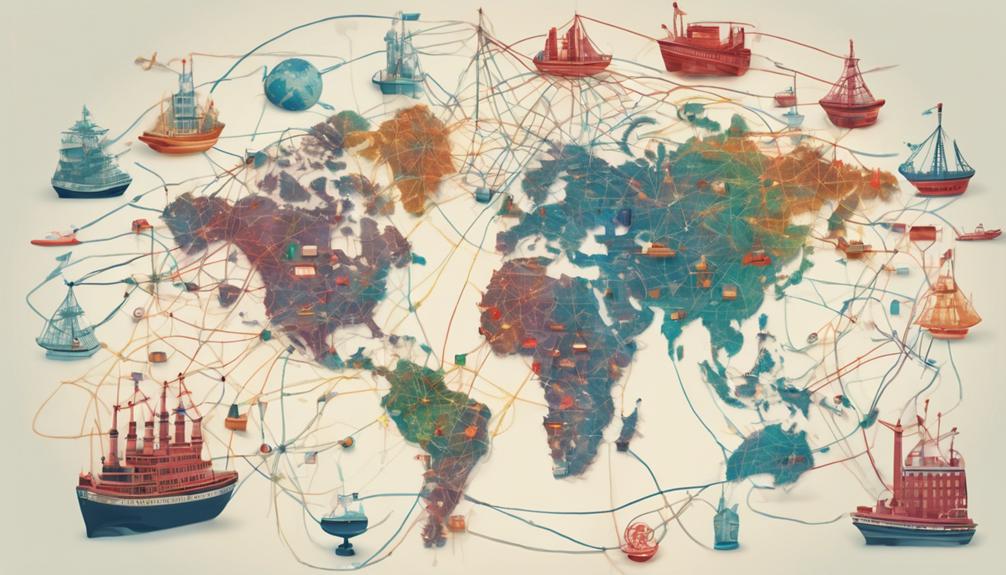
We navigate the intricate web of international trade agreements every day, where a single misstep in understanding tariffs, quotas, and regulatory frameworks can make all the difference between success and failure in the global marketplace. From the evolution of trade agreements to maneuvering tariffs and quotas, regulatory frameworks, and regional trade blocs, there's a lot to unpack. Disputes are common, and understanding how to mitigate risks is essential. As we delve into the complexities, we're about to uncover the nuances that shape international trade – and discover how to stay ahead in this intricate landscape.
The Evolution of Trade Agreements
As we explore the world of international trade agreements, it's clear that these pacts have undergone significant transformations over the centuries. From ancient times to the present day, trade agreements have evolved to reflect changing global circumstances, technological advancements, and shifting economic priorities.
In the early days, trade agreements were largely bilateral, with nations negotiating one-on-one to establish trade relationships. The 19th and early 20th centuries saw the rise of colonial empires, leading to the imposition of trade agreements that favored the dominant powers. However, as decolonization and globalization gained momentum, the need for all-encompassing agreements grew. This led to the establishment of institutions like the General Agreement on Tariffs and Trade (GATT) in 1947, which aimed to reduce trade barriers and promote economic cooperation.
The post-World War II era saw a proliferation of regional trade agreements, such as the European Economic Community (EEC), which laid the groundwork for the modern European Union. The 1990s brought about a new wave of bilateral and multilateral agreements, including the North American Free Trade Agreement (NAFTA) and the World Trade Organization (WTO). Today, we're witnessing a new era of mega-regional agreements, such as the Comprehensive and Progressive Agreement for Trans-Pacific Partnership (CPTPP) and the United States-Mexico-Canada Agreement (USMCA). As we navigate this complex landscape, it's essential to understand the evolution of trade agreements and their ongoing impact on global commerce.
Navigating Tariffs and Quotas
We often find ourselves maneuvering through a complex web of tariffs and quotas, which can either hinder or facilitate international trade, depending on how effectively we comprehend and manage them. These trade restrictions can be a significant obstacle to traversing the global market, but with a solid understanding of their implications, we can turn them into opportunities. By understanding global economic policies, businesses can better anticipate changes in trade regulations and adjust their strategies accordingly. This awareness allows companies to mitigate risks, optimize supply chains, and capitalize on emerging market opportunities. Ultimately, a well-informed approach to tariffs and quotas can transform potential barriers into competitive advantages.
Tariffs, or taxes on imported goods, can increase the cost of doing business abroad. However, we can mitigate their impact by identifying and leveraging low-tariff or tariff-free zones. Quotas, on the other hand, limit the quantity of goods that can be imported or exported, and we must carefully manage our supply chains to avoid exceeding these limits.
Effective management of tariffs and quotas requires a deep understanding of the trade agreements in place. We must stay up-to-date on the latest negotiations and agreements, as well as the rules of origin and other requirements that govern trade. By doing so, we can optimize our trade strategies, minimize costs, and maximize opportunities.
Ultimately, handling tariffs and quotas is a delicate balancing act, requiring careful planning and strategic decision-making. By staying informed and adapting to the ever-changing landscape of international trade, we can turn these restrictions into opportunities for growth and expansion.
Regulatory Frameworks Explained
Having navigated the complex landscape of tariffs and quotas, we now turn our attention to the regulatory frameworks that underpin international trade agreements, providing the foundation for facilitating or hindering global commerce. These frameworks consist of laws, regulations, and standards that govern the flow of goods and services across borders. They shape the business environment, influencing the decisions of exporters, importers, and investors alike.
We find that regulatory frameworks can be broadly categorized into two types: mandatory and voluntary. Mandatory frameworks are legally binding, often imposed by governments to guarantee compliance with international standards or to protect domestic industries. Voluntary frameworks, on the other hand, are industry-driven, aiming to promote best practices and self-regulation. Both types have a significant impact on trade, as they can create barriers to entry or facilitate market access.
A well-designed regulatory framework can simplify customs procedures, reduce bureaucratic hurdles, and increase transparency. Conversely, a complex or opaque framework can lead to confusion, delays, and additional costs. As we explore further into the world of international trade agreements, it's essential to understand the intricacies of regulatory frameworks and their far-reaching implications. By doing so, we can better navigate the complexities of global commerce and uncover new opportunities for growth and cooperation.
Regional Trade Blocs and Effects
Here's the output:
Regional trade blocs, such as the European Union, the North American Free Trade Agreement, and the Association of Southeast Asian Nations, have emerged as powerful forces shaping the global trade landscape. As we explore further into the complexities of international trade agreements, it's vital to understand the role of regional trade blocs in facilitating trade and investment.
These blocs aim to reduce trade barriers, increase economic integration, and enhance competitiveness among member countries. We've seen significant benefits from these agreements, including increased trade volumes, improved market access, and job creation.
| Regional Trade Bloc | Member Countries | Key Objectives |
|---|---|---|
| European Union (EU) | 27 European countries | Single market, economic integration, and political cooperation |
| North American Free Trade Agreement (NAFTA) | US, Canada, Mexico | Eliminate tariffs, promote trade, and increase investment |
| Association of Southeast Asian Nations (ASEAN) | 10 Southeast Asian countries | Economic growth, social progress, and cultural development |
We've witnessed the positive impact of regional trade blocs on economic development, particularly in emerging markets. By fostering cooperation and reducing trade barriers, these agreements have created new opportunities for businesses, investors, and consumers alike. As we navigate the intricacies of international trade agreements, it's essential to recognize the significant role regional trade blocs play in shaping the global trade landscape.
Mitigating Dispute Resolution Risks
Frequently, international trade agreements give rise to disputes that can be costly and time-consuming to resolve, highlighting the need for effective dispute resolution mechanisms to mitigate risks and guarantee trade continuity. As we explore the complexities of international trade agreements, we realize that disputes can arise from various sources, including disagreements over tariffs, intellectual property rights, and regulatory requirements.
We've learned that having a clear understanding of the dispute resolution process is essential in mitigating risks. This includes knowing the procedures for filing complaints, the role of mediators and arbitrators, and the rules governing evidence and testimony. Effective dispute resolution mechanisms can help prevent trade disruptions, reduce uncertainty, and promote cooperation among nations.
To mitigate dispute resolution risks, we recommend that countries establish clear and transparent procedures for resolving disputes. This can include establishing a clear hierarchy of dispute resolution mechanisms, from mediation to arbitration, and ensuring that all parties have access to fair and impartial proceedings. By doing so, we can reduce the risk of trade disruptions, promote cooperation, and ensure that international trade agreements remain effective in facilitating global trade. By understanding the complexities of dispute resolution, we can better navigate the intricacies of international trade agreements and promote a more stable and prosperous global economy.
Frequently Asked Questions
What Is the Impact of Cultural Differences on Trade Agreements?
We've found that cultural differences have a significant impact on trade agreements. We've seen how varying values, norms, and communication styles can lead to misunderstandings and conflicts. For instance, what's considered polite in one culture might be seen as rude in another. We've learned that being aware of these differences is essential in negotiating successful trade agreements. By acknowledging and respecting cultural disparities, we can foster stronger, more effective partnerships that benefit all parties involved.
How Do Trade Agreements Affect Small and Medium-Sized Enterprises?
As we navigate the global marketplace, we find that trade agreements can be a double-edged sword for small and medium-sized enterprises (SMEs). On one hand, they offer access to new markets and customers, symbolizing a key that opens up new opportunities. However, they can also bring increased competition, threatening to drown out the voices of SMEs. We've seen how stricter regulations and tariffs can stifle innovation and growth, leaving SMEs struggling to stay afloat.
Can Governments Renegotiate Existing Trade Agreements?
We're often asked if governments can renegotiate existing trade agreements. The answer is yes, they can. In fact, it's a common practice. Governments may want to renegotiate due to changes in economic conditions, shifts in political priorities, or to address concerns raised by stakeholders. We've seen this happen with agreements like NAFTA, which was renegotiated and replaced by the USMCA. Renegotiation allows governments to adapt agreements to new circumstances, ensuring they remain relevant and effective.
What Role Do Non-Governmental Organizations Play in Trade Agreements?
We're curious about the role of non-governmental organizations (NGOs) in trade agreements. Turns out, NGOs play a significant role in shaping trade policies. They raise awareness about social and environmental concerns, influencing governments to incorporate their concerns into agreements. We've seen NGOs push for labor rights, environmental protections, and consumer safety standards. Their advocacy helps guarantee trade agreements balance economic interests with social and environmental responsibilities.
How Do Trade Agreements Address Environmental and Labor Standards?
We're looking at how trade agreements tackle environmental and labor standards. Honestly, it's a mixed bag. Some agreements, like the USMCA, have strengthened environmental and labor protections. Others, like the TPP, have been criticized for being too weak in these areas. We've seen some agreements include provisions to promote sustainable development, while others have faced backlash for prioritizing economic gains over social and environmental concerns.