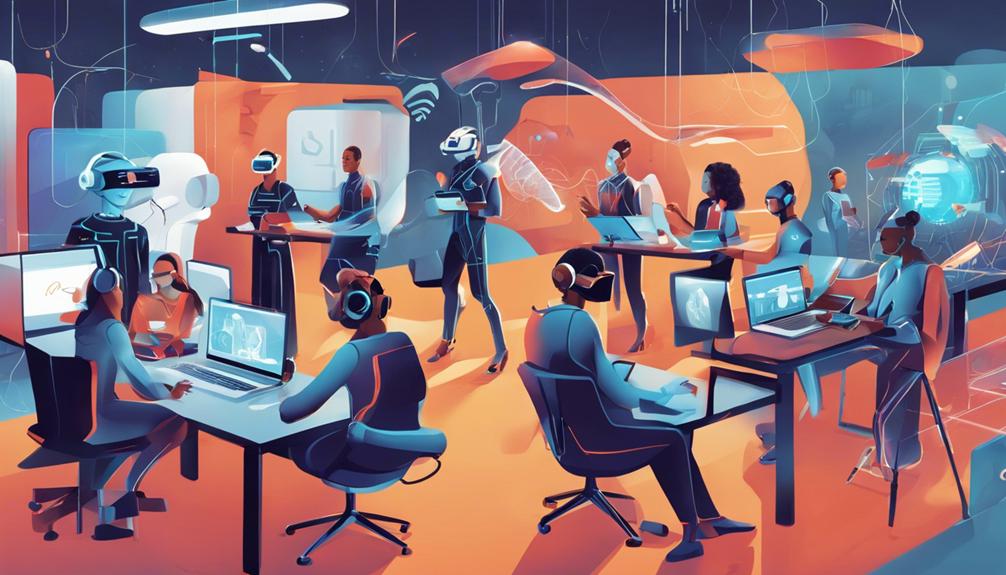
We're witnessing a seismic shift in the workplace, as traditional 9-to-5 office schedules give way to flexible work arrangements that prioritize productivity, inclusivity, and work-life balance. With remote work, we're enjoying improved work-life balance, increased productivity, and new opportunities for people with disabilities, caregivers, and those in rural areas. Technology advancements are facilitating virtual collaboration, and AI is streamlining workflows. Meanwhile, VR is changing the game with immersive experiences for collaboration and communication. As we move forward, we're shaping the future of employment to be more equitable, inclusive, and beneficial for all – and there's more to discover.
Remote Work Revolution Gains Momentum
As we increasingly trade in our commutes for couches and coffee shops, the remote work revolution is gaining momentum, with a significant uptick in flexible work arrangements across various industries. We're no longer tied to traditional 9-to-5 office schedules, and it's liberating. With the rise of remote work, we're seeing a shift in the way we approach our careers and personal lives. Gone are the days of tedious commutes and rigid office schedules; we're embracing a more flexible and autonomous way of working.
As we adapt to this new normal, we're noticing a significant improvement in work-life balance. We're no longer confined to a specific location or schedule, allowing us to prioritize our personal lives and well-being. This newfound flexibility has also led to increased productivity, as we're able to work from wherever we're most comfortable and focused. Additionally, remote work has opened up new opportunities for people with disabilities, caregivers, and those living in rural areas.
As we continue to navigate this remote work revolution, we're excited to see how it will shape the future of employment. With the ability to work from anywhere, we're no longer limited by geographical constraints. We're free to pursue careers that align with our passions and values, without being restricted by location. The possibilities are endless, and we're thrilled to be a part of this transformative shift in the way we work.
Technology Drives Virtual Collaboration
By leveraging innovative tools and platforms, we're bridging geographical gaps and fostering seamless virtual collaboration in real-time. This has been a game-changer for remote teams, allowing us to work together efficiently and effectively, regardless of our physical locations. With the help of video conferencing tools, we can hold virtual meetings, share screens, and engage in face-to-face discussions as if we were in the same room.
Cloud-based project management platforms have also become essential for remote collaboration. These platforms enable us to share files, track progress, and assign tasks with ease. We can access project information from anywhere, at any time, and receive real-time updates on task statuses. This level of transparency and accessibility has greatly improved our productivity and accountability.
Moreover, instant messaging apps have become an indispensable tool for remote teams. We use them to communicate quickly and informally, sharing ideas, asking questions, and providing feedback in real-time. These apps have also enabled us to create virtual "watercooler" spaces, where we can socialize and build relationships with colleagues, even if we're not physically in the same office.
As technology continues to advance, we're excited to see how it will further enhance our virtual collaboration capabilities. With the right tools and platforms, we're confident that we can achieve even greater levels of productivity, innovation, and success in the remote work landscape.
Artificial Intelligence Boosts Productivity
Through the strategic integration of artificial intelligence, we're streamlining our workflows, automating mundane tasks, and freeing up more time for creative problem-solving and high-leverage activities. This means we can focus on what matters most: driving innovation, improving customer experiences, and pushing the boundaries of what's possible. AI-powered tools are taking care of tedious tasks like data entry, bookkeeping, and customer service chatbots, allowing us to redirect our energy towards high-impact projects.
We're also leveraging AI-driven analytics to gain deeper insights into our operations, identifying areas for improvement and opportunities for growth. By analyzing vast amounts of data, we're able to pinpoint trends, patterns, and correlations that would be impossible to detect manually. This enables us to make data-driven decisions, optimize our processes, and respond to changing market conditions with agility.
Moreover, AI is helping us personalize our services and products, tailoring them to individual needs and preferences. This level of customization was previously unimaginable, but with AI, we can now deliver targeted solutions that resonate with our customers on a deeper level. As we continue to harness the power of artificial intelligence, we're confident that our productivity, efficiency, and innovation will reach new heights.
Virtual Reality Changes the Game
We're revolutionizing the way we work and interact with each other by incorporating virtual reality into our daily operations. This technology is changing the game by providing immersive experiences that simulate real-world environments, allowing us to collaborate, train, and communicate more effectively. With VR, we can recreate complex scenarios, practice high-stakes tasks, and connect with others across the globe as if we're in the same room.
Virtual reality is particularly useful in industries that require hands-on training, such as healthcare, manufacturing, and aviation. By simulating real-world scenarios, professionals can practice and refine their skills without risking real-world consequences. Additionally, VR enables remote teams to collaborate more effectively, fostering a sense of presence and community that’s often lacking in traditional remote work arrangements. As the evolution of drone technology advances, VR can be integrated to enhance remote piloting and training for drone operators in fields like logistics, surveillance, and disaster response. This combination allows users to experience realistic flight conditions and improve their decision-making skills in a risk-free environment. Ultimately, the synergy between VR and emerging technologies is transforming the way professionals train, collaborate, and innovate across various industries.
Here are some examples of how VR is being used in different industries:
| Industry | Application | Benefit |
|---|---|---|
| Healthcare | Surgical training | Improved accuracy and reduced risk |
| Manufacturing | Virtual factory tours | Enhanced collaboration and reduced costs |
| Aviation | Flight simulation | Increased safety and reduced training time |
| Education | Virtual field trips | Increased engagement and accessibility |
Shaping the Future of Employment
As remote employment becomes the new norm, our workforce is poised to undergo a seismic shift, driven largely by technological advancements that are redefining traditional notions of work and employment. We're no longer bound by geographical constraints, and this freedom is opening up new opportunities for people from all walks of life. As we navigate this shift, we're forced to reexamine our assumptions about what it means to be employed and what constitutes a 'job.'
We're moving away from the traditional 9-to-5 grind and embracing flexible, autonomous work arrangements that prioritize output over hours clocked. This shift is empowering individuals to take ownership of their work and create schedules that align with their unique needs and lifestyles. It's also allowing us to tap into global talent pools, fostering diversity and innovation on a massive scale.
As we shape the future of employment, we're not just creating new jobs – we're creating new industries. We're harnessing the power of AI, blockchain, and other emerging technologies to solve complex problems and create value in ways we never thought possible. The possibilities are endless, and it's up to us to make sure that this brave new world of work is equitable, inclusive, and benefits everyone.
Frequently Asked Questions
How Do I Maintain a Work-Life Balance While Working Remotely Full-Time?
'As the saying goes, 'all work and no play makes Jack a dull boy.' We've learned that maintaining a work-life balance while working remotely full-time is essential. We set boundaries by creating a dedicated workspace, establishing a routine, and scheduling personal time. We prioritize self-care, take breaks, and disconnect from work-related tasks outside of work hours. By doing so, we're able to recharge and avoid burnout, ensuring our productivity and overall well-being.'
Can Ai-Powered Tools Replace Human Managers in a Remote Work Setup?
We're wondering if AI-powered tools can replace human managers in a remote work setup. Honestly, we think it's unlikely. While AI can automate tasks and provide data insights, it lacks the empathy and social skills human managers bring to the table. AI can't replicate the emotional intelligence and nuance required to motivate and support team members, especially in remote settings where human connection is essential.
Are Virtual Reality Training Programs More Effective Than Traditional Methods?
We've explored the idea of AI-powered tools replacing human managers, but now we're wondering if virtual reality training programs are more effective than traditional methods. From our perspective, VR training offers a more immersive experience, allowing us to practice skills in a realistic, risk-free environment. This leads to better retention rates and improved performance. We believe VR training is the way to go – it's more engaging, interactive, and effective in the long run.
How Do Companies Ensure Data Security in a Remote Work Environment?
We're aware that 64% of companies have experienced a cyberattack in the past year, making data security a top priority in remote work environments. To guarantee data security, we implement robust protocols like multi-factor authentication, encryption, and regular software updates. We also educate our remote team members on best practices, such as using secure networks and avoiding phishing scams. By taking these proactive measures, we can safeguard our company's sensitive information.
Will Remote Employees Face Social Isolation and Mental Health Issues?
We're worried that working from home can be isolating, leading to feelings of loneliness and disconnection. Without daily interactions with colleagues, we might struggle to maintain social connections, which are vital for our mental well-being. If we're not careful, remote work could lead to social isolation, depression, and anxiety. We need to prioritize building virtual communities and encouraging regular check-ins to combat these potential mental health issues.